If your company holds an ISO 9001 certification, or is working toward one, you have probably heard that a new version is coming! ISO 9001:2026 is expected to be published in September 2026, and it officially starts a three-year transition clock for every certified organization in the world.
Here is the short version: the changes are real but manageable. Certification bodies are expected to grant companies a three-year transition window, consistent with past revisions. This article explains what is actually changing, what it means for your business, and what you should be doing right now.
What Is ISO 9001:2026?
ISO 9001 is the international standard for Quality Management Systems (QMS). It is the baseline requirement for doing business with most major manufacturers, aerospace primes, and government contractors. The current version, ISO 9001:2015, has been in place for a decade.
ISO 9001:2026 is the next revision. It is not a radical overhaul. Think of it as an update, not a rebuild. The core structure, Clauses 4 through 10, remains largely intact. Most companies already certified to ISO 9001:2015 and running a healthy QMS will not face a heavy lift.
That said, there are meaningful changes that leadership needs to understand, because a few of them land directly in the executive suite.
What Is Actually Changing?
-
Leadership Is Now on the Hook for Quality Culture
The most significant shift for business owners and executives is in Clause 5.1. The 2026 version explicitly requires top management to actively promote and demonstrate a quality culture and ethical behavior throughout the organization, not just sign off on a quality policy.
In practice, your certification auditor will look for evidence that leadership is genuinely engaged: setting the tone, reinforcing quality values in day-to-day decisions, and modeling the behavior they expect from their teams. A quality manual on a shelf and a policy posted on the wall will not be enough.
For most small and mid-sized manufacturers in Southern California, this is good news. If you are already running your business with integrity and accountability, you are already doing what the standard asks. You just need to make it visible.
-
Climate Change Is Now Part of the QMS
ISO 9001:2026 formally includes climate change and sustainability in the organizational context requirements under Clause 4.1. This is not entirely new. It was added to ISO 9001 via an amendment in 2024. And it does not require an environmental management system. That is ISO 14001. What it does require is that you consider whether climate-related factors are relevant to your business and your customers’ expectations.
For manufacturers in Orange County or Los Angeles, relevant questions include:
-
Do our customers or contracts require Environmental, Social, and Governance (ESG) reporting?
-
Are we part of a larger organization with published ESG commitments?
-
Are there regulatory requirements we need to meet regarding climate change or ESG reporting?
-
Is sustainability part of our quality strategy?
-
Opportunities Get Their Own Spotlight
Risks and opportunities are not new to ISO 9001. Both were introduced in the 2015 version. What is new in 2026 is a dedicated section titled “Actions to Address Opportunities.” The intent and the language remain consistent with how risks are handled. Both are treated under the same framework. The difference is structural: each now has its own section, giving opportunities more visible emphasis within the standard.
-
Change Management Requirements Are Enhanced
Clause 6.3, which governs how your organization plans for change, now includes additional considerations. Under ISO 9001:2026, planned changes must explicitly account for effectiveness, communication, and post-change review. If your company has gone through growth, restructuring, or significant process changes recently, your QMS documentation should reflect how those changes were managed.
-
A New Guidance Annex
ISO 9001:2026 includes Annex A, a 15-page supplementary guidance section. It is non-mandatory, but it clarifies the intent behind key clauses in plain language. For companies that have found the standard difficult to interpret, this is a practical addition.
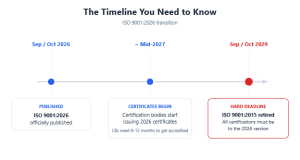
Three years sounds like a long time. It is not, especially when annual surveillance audits and a recertification cycle are in the mix. Your Certification Body will communicate their specific transition plans in time. Learning about the changes now puts you ahead. Just be selective about your sources. A significant amount of misinformation has been circulating about what ISO 9001:2026 actually requires.
What Should You Do Right Now?
You do not need to overhaul your QMS today. For most organizations, a full overhaul is not expected even once the transition period begins. But there are three things worth doing before the standard is published:
-
Review the changes. The Final Draft International Standard (FDIS) is already available. Most certified companies will find the gaps smaller than expected. Skip the standalone gap analysis. The changes are narrow enough to be addressed within your existing internal audit process, as long as your auditors understand what is coming.
-
Brief your leadership team. The new leadership requirements are not a paperwork exercise. Business owners and executives need to understand their responsibilities before an audit surfaces it. A half-day session is usually enough to get leadership aligned.
-
Talk to your Certification Body (CB). Your CB will publish their own transition plan. Ask about their accreditation timeline, what they will expect at upcoming audits, and whether your recertification date creates any scheduling considerations.
A Note on AS9100, ISO 13485, and IATF 16949
If you are certified to one of these industry-specific standards, ISO 9001:2026 affects you too, with one caveat. AS9100, ISO 13485, and IATF 16949 are all built on top of ISO 9001. When ISO 9001 is revised, these standards eventually follow.
Timing varies, and formal updates for industry-specific standards, with the exception of AS9100, have not yet been announced. For now, monitor guidance from your industry’s governing body and stay in contact with your CB. The practical approach is to manage your ISO 9001 transition and flag downstream implications early.
Let Factor Quality Perform Your Next Internal Audit
If you are not sure where your QMS stands against the new requirements, Factor Quality offers internal audit services that can integrate a gap assessment. Our team executes internal audits for manufacturers throughout Orange County, Los Angeles, and San Diego. We have helped over 200 companies implement and maintain their quality systems, and we know how to make a transition like this efficient and low-disruption.
Ready to get ahead of it? Contact us to schedule a conversation.